
A suspension risk audit looks for the things Google suspends profiles over, before Google finds them: a business name with words that are not on the sign, an address customers cannot visit, a category that does not match what the business is, a virtual office, a profile for a business that has moved, and access held by people who no longer work there. None of this is about ranking. It is about whether the profile survives the next review.
A Google Business Profile suspension does not drop you a few places. It disappears, along with the reviews customers left on it, usually on a Tuesday, usually with no warning and no explanation beyond a line in the dashboard.
The appeal process exists, and it works often enough, but Google is clear that an appeal can only be submitted once. That single sentence is the reason this audit is worth half an hour. You get one proper attempt, so the time to get the profile in order is before anything happens, not after.
Where suspensions come from
Almost every suspension traces back to the guidelines for representing your business, together with the eligibility rules that say which businesses may have a profile at all. The guidelines are not long. Most businesses have simply never read them.
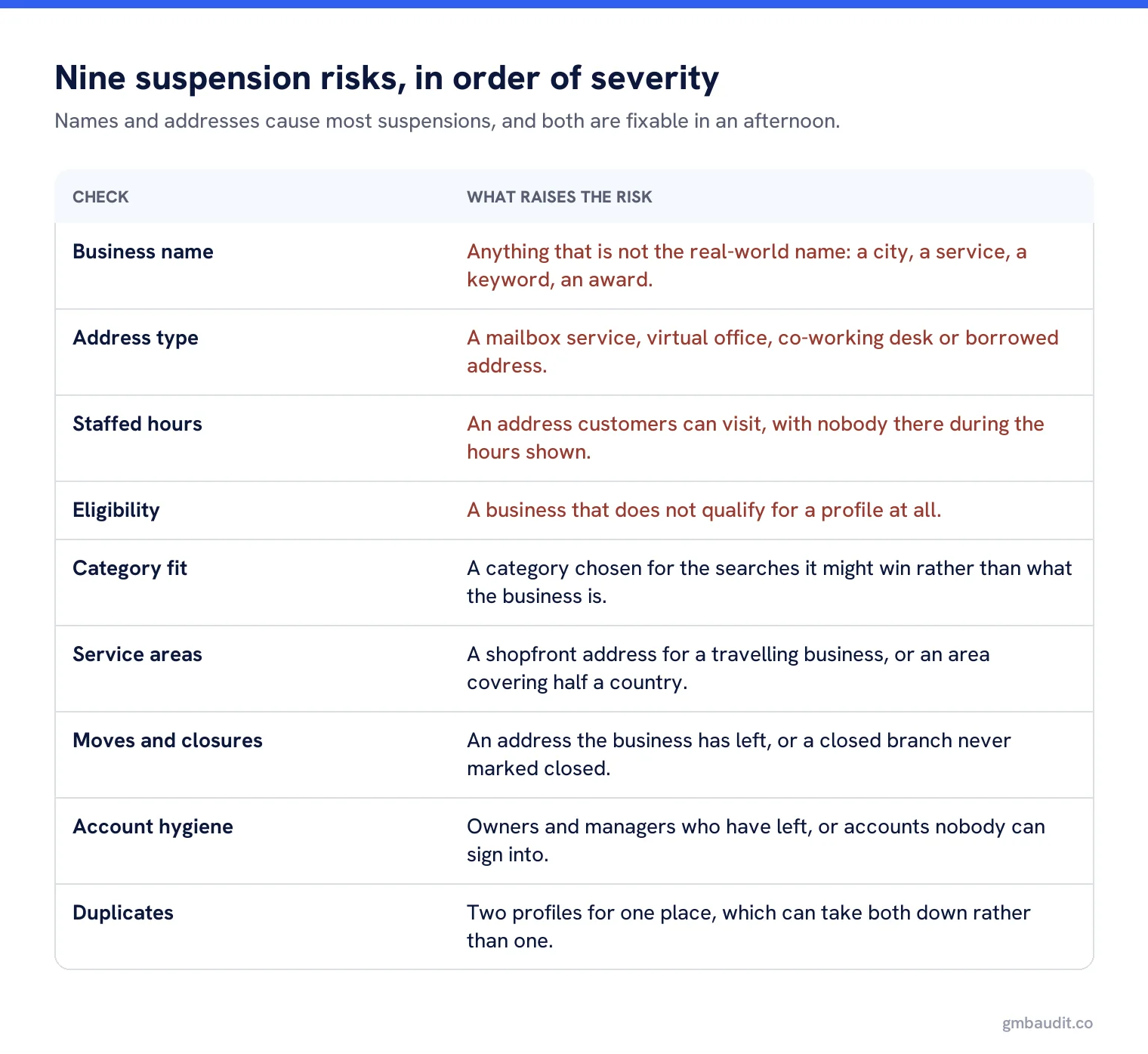
The nine checks
| Check | What raises the risk | Severity |
|---|---|---|
| Business name | Anything that is not the real-world name: a city, a service, a keyword, an award, a phone number. | High |
| Address type | A mailbox service, a virtual office, a co-working desk, or a rented meeting room used as a registered address. | High |
| Staffed hours | An address customers can visit, but nobody there during the hours shown. | High |
| Eligibility | A business that does not qualify at all: a property for rent, an ongoing online-only service, a lead generation front. | High |
| Category fit | A category chosen for the searches it might win rather than for what the business is. | Medium |
| Service area setup | A shopfront address shown when the business actually travels to customers, or an area covering half a country. | Medium |
| Moves and closures | A profile still showing an address the business left, or a closed branch never marked as closed. | Medium |
| Account hygiene | Owners and managers who have left, agencies no longer engaged, personal accounts nobody can log into. | Medium |
| Duplicates | Two profiles for one place, which can take both down rather than one. | Medium |
The name check, done properly
This is the one that catches most businesses, because the extra words usually worked for a while. Stand outside the premises, or look at the picture of the front. Whatever is on the sign, the van and the invoice is the name. Everything else comes off.
- “Harrow Plumbing” is a name, if that is the name.
- “Harrow Plumbing | Emergency Plumber Harrow, 24/7” is four things and a name.
- A legal entity name nobody uses in public is not the real-world name either.
Removing keywords from a name does feel like giving something up, and sometimes visibility moves afterwards. It is still the right call: a profile carrying a breach is a profile waiting for somebody to report it.
The address check, done properly
Ask one question: can a customer turn up at this address during the hours shown and be served by a person? If the answer is no, the address should not be on the profile and the business should be set up to serve a service area instead. Mailbox shops, virtual offices and addresses borrowed from a relative are the three that come up again and again.
Service areas themselves need a sanity check. A plumber covering four towns is believable. A plumber covering an entire country is a flag, and it is also useless, because it tells a searcher nothing.
Who can still get in
Access is a risk even when nothing is wrong with the listing. Audit the owner and manager list the way you would audit keys to the building. A former agency that still holds owner rights can change anything on the profile, and an owner account tied to a personal address that nobody can reach any more is a problem you only discover on the day you urgently need it.
If it has already happened
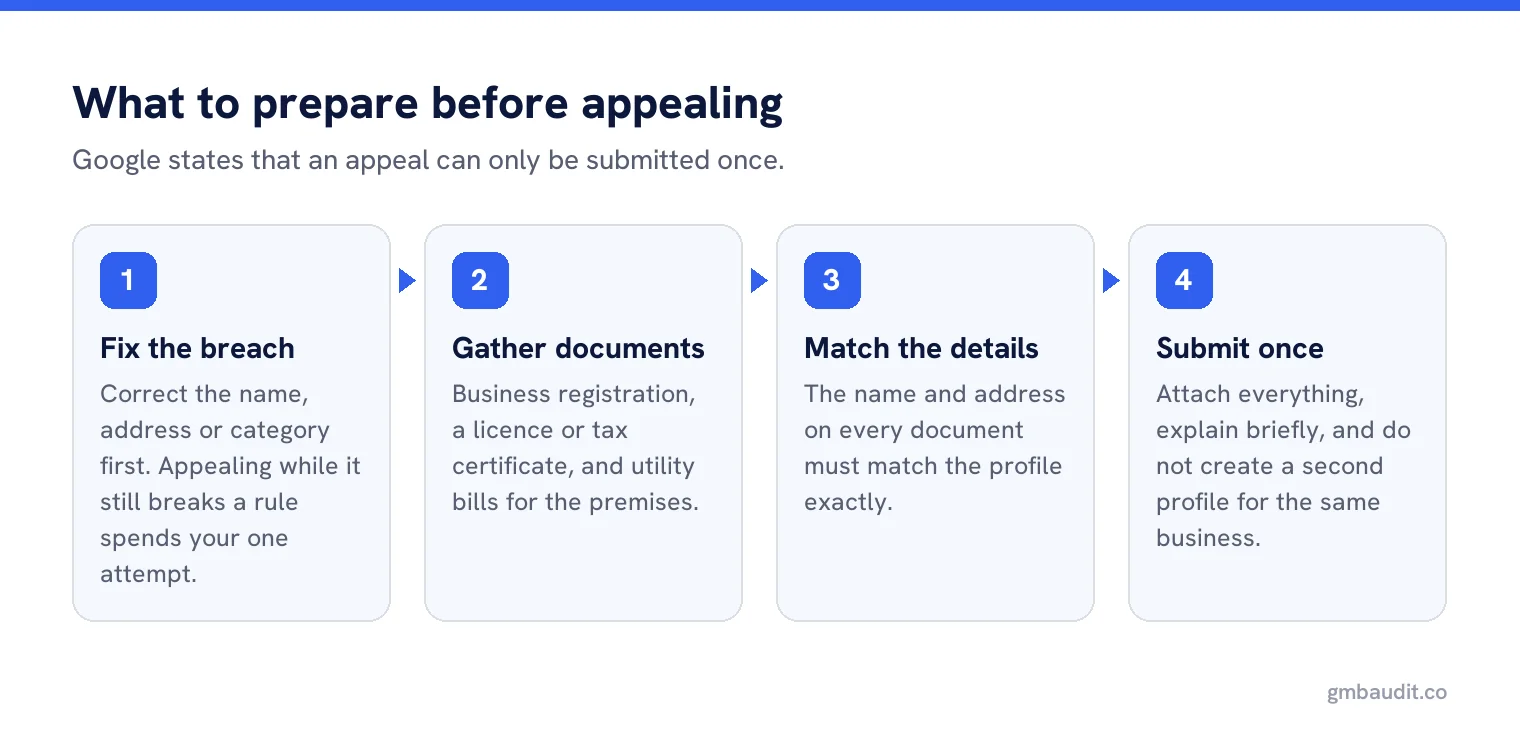
If the profile is already suspended, two instructions matter more than the rest. Google says plainly: do not create a new profile for the same business, and prepare evidence before you appeal, because you only get the one go. Useful evidence is the dull kind, listed on Google’s own appeals page:
Registration or licence
Official business registration, a licence, or a tax certificate.
Utility bills
Electricity, phone, water or internet for the business premises.
Matching details
The name and address on every document must match the profile exactly. A trading name on the listing and a limited company name on the bill is the most common reason a good appeal fails.
Fix the breach first, then appeal. Appealing while the name still has three keywords in it spends your single attempt on a profile that still breaks the rule. There is a fuller walkthrough of the process in our guide to a suspended Google Business Profile.
Things that are not a risk
Half the worry in local SEO forums is about things that have never suspended anybody. Asking customers for reviews is allowed, as long as you do not offer anything in return. Replying to a bad review is allowed. Changing your hours often is allowed. Having fewer photos than a competitor is not a policy matter at all. Spending your audit time on these is how real breaches stay on a profile for years.
How often to run this one
Twice a year for a settled business, and immediately after any of these: a move, a rebrand, a change of phone number, a new agency, a staff change that touched the Google account, or opening a second location. Those are the moments when somebody edits the profile in a hurry, and hurry is what creates breaches.
Find the risks before a reviewer does
Our audit checks names, addresses, categories and access across every profile you manage, and flags the ones that break a rule.
Frequently asked questions
What gets a Google Business Profile suspended?
Most often a business name with extra keywords, an address customers cannot visit such as a mailbox or virtual office, or a business that is not eligible for a profile at all.
Can I appeal a suspension more than once?
No. Google states that an appeal can only be submitted once, which is why you fix the breach and gather evidence before you start.
Should I create a new profile while suspended?
No. Google says explicitly not to create a new Business Profile for the same business. It makes the situation harder to resolve, not easier.
What evidence helps an appeal?
Business registration, a licence or tax certificate, and utility bills for the premises. The name and address on them must match the profile exactly.
How often should I run a suspension risk audit?
Twice a year, and straight after a move, a rebrand, a new agency or any change to who holds the Google account.
Sources
The Google documentation behind the guidance on this page. Google changes these pages without notice, so check the date on any figure before you rely on it.