
A category audit asks three questions. Is the primary category the most specific one that describes what the business is? Are the additional categories genuine departments rather than a list of services? And do the businesses ranking above you use something different? Google states that the categories you select affect your local ranking, and changing a category can trigger a request to verify again, so this is the highest value check on a profile and the one most likely to be wrong.
A Google Business Profile category audit exists because categories get chosen once, in a hurry, by whoever set the profile up. Then the business changes and the category does not. A decorator becomes a plastering firm, a cafe starts doing dinner, a mobile mechanic opens a unit, and the category still says what the business used to be.
What Google actually says
Three rules from Google’s page on managing categories do most of the work in an audit:
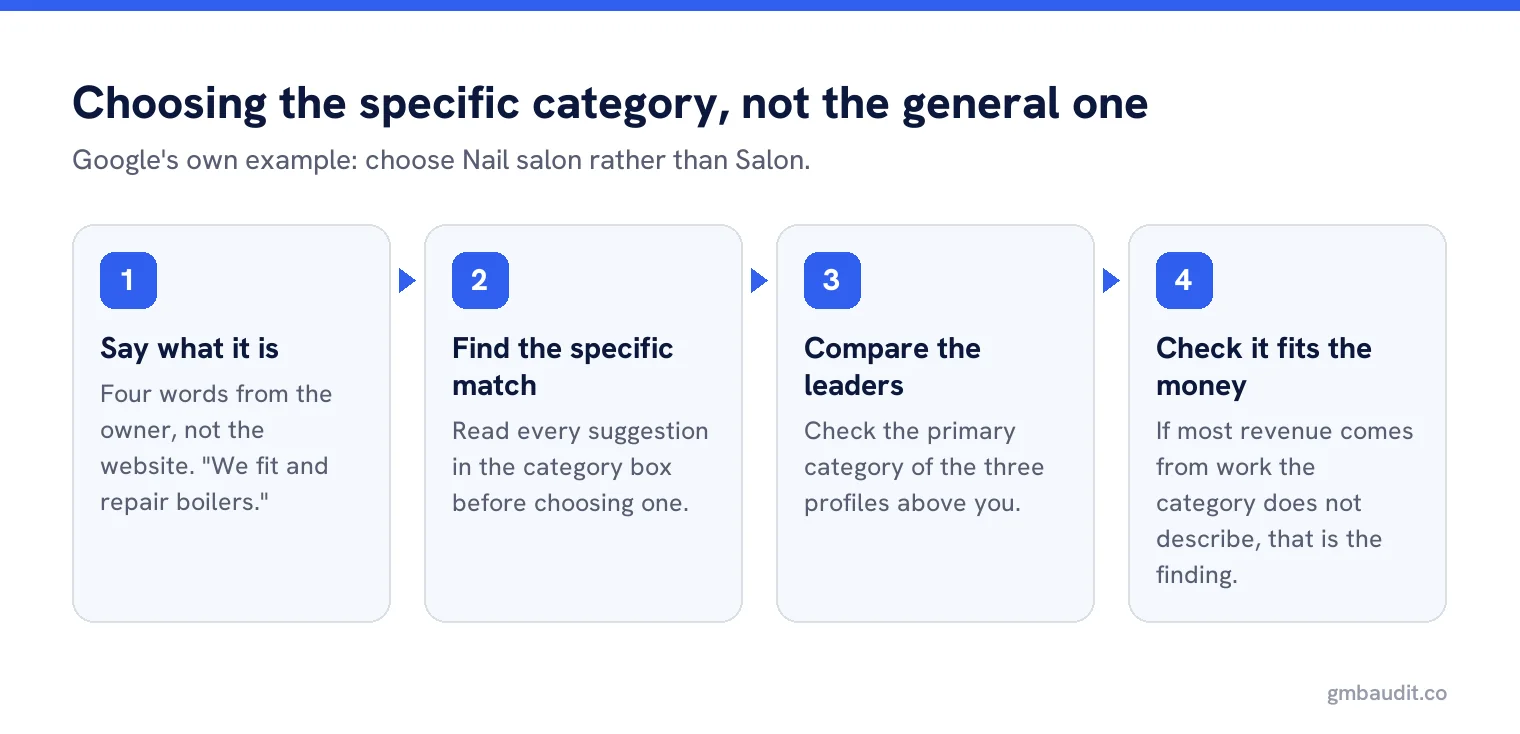
- Pick the specific category, not the general one. Google’s own example: choose “Nail salon” rather than “Salon”.
- Use as few as possible. Additional categories are for special departments or services, not for every product you sell.
- Independent businesses inside your premises get their own profile. A health club with an independently run cafe should not add “Cafe”.
The guidelines add a test worth saying out loud each time: a category should complete the sentence “this business is a”, not “this business has a”. A hotel is a hotel. It has a restaurant. The restaurant is only an additional category if it is genuinely a department of the same business.
Auditing the primary category
Write down what the business is, in four words
Ask the owner, not the website. “We fit and repair boilers.” That sentence is the brief.
Find the most specific match
Type the words into the category box and read every suggestion before choosing. The list is longer than most people realise, and the right one is often two words you did not expect.
Compare with the leaders
Check the primary category of the three profiles above you for your main search. Agreement among all three is a strong signal. Disagreement means the search is mixed and either may be fine.
Check it still fits the money
If 70 per cent of revenue comes from a service that the primary category does not describe, you have found the finding.
Auditing the additional categories
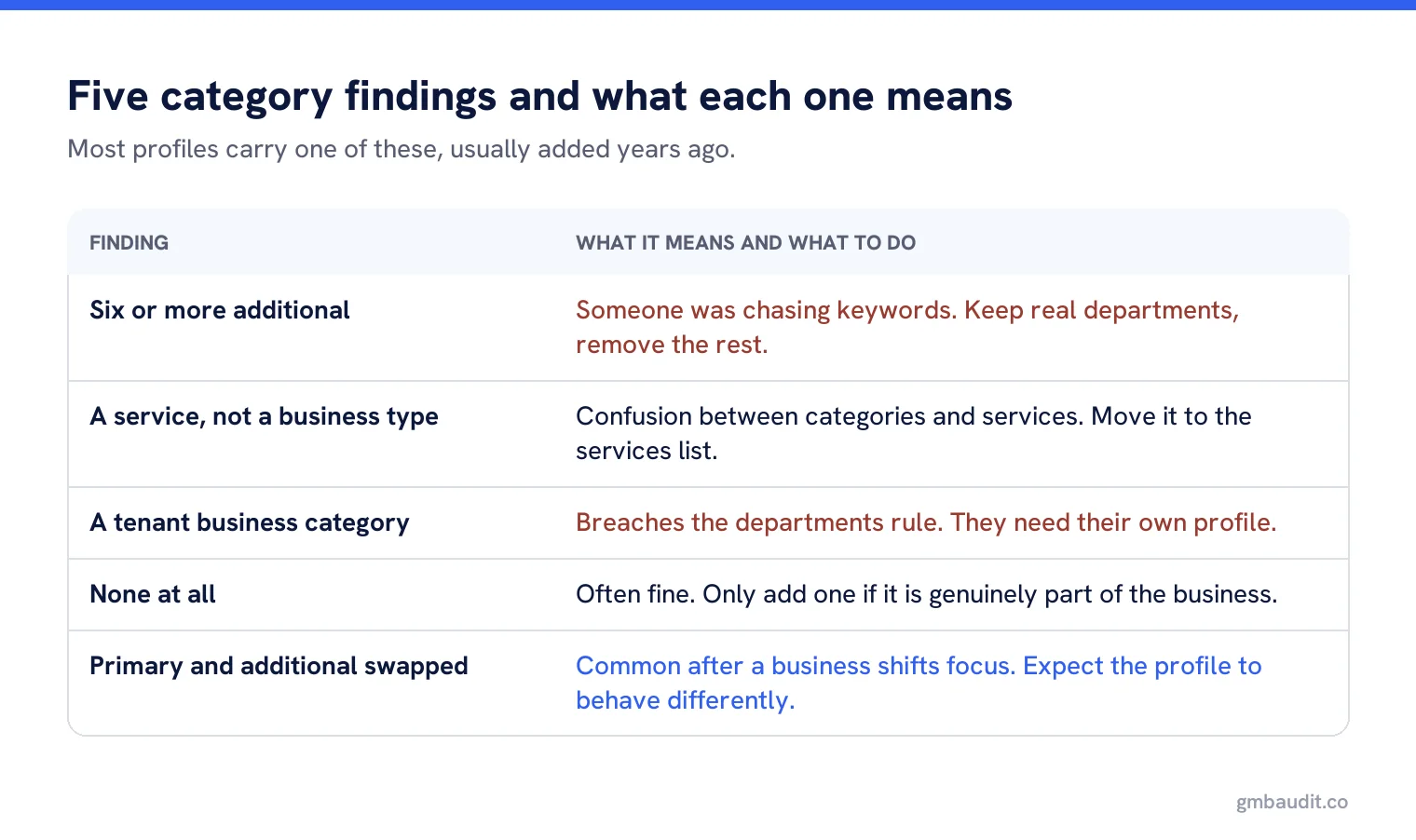
Open the list and justify each one in a sentence. Anything you cannot justify comes off. The usual offenders are categories added to chase searches: a bathroom fitter with “Plumber”, “Tiler”, “Builder”, “Kitchen remodeler” and “Handyman” has not widened their reach, they have blurred what the profile is.
| Finding | What it usually means | Action |
|---|---|---|
| Six or more additional categories | Someone was chasing keywords. | Keep the ones that are real departments. Remove the rest. |
| A category for a service, not a business type | Confusion between categories and the services list. | Move it into services, where it belongs. |
| A category for a tenant business | Breaches the departments rule. | Separate profile for them, remove from yours. |
| No additional categories at all | Often fine. Sometimes a missed department. | Only add one if it is genuinely part of the business. |
| Primary and additional the wrong way round | Common after a business shifts focus. | Swap them, and expect the profile to behave differently. |
What changing a category costs you
Google warns that if you add or edit an existing category you might be asked to verify the business again. That is not a reason to leave a wrong category in place, but it is a reason to plan the change rather than do it on a Friday afternoon before a bank holiday.
Two more things to expect. Category-specific features come and go with the category: Google notes that hotels can show class ratings, restaurants can add menus and ordering links, and health and beauty businesses can add a booking button. Change the category and those sections may appear or vanish. And because categories affect which searches you match, visibility can move in both directions for a few weeks before it settles.
Two worked examples
A garden business. Primary category “Landscaper”. Additional: “Gardener”, “Tree service”, “Fencing contractor”, “Garden centre”. The owner says 80 per cent of the work is weekly maintenance for regular customers. “Landscaper” describes design and build, which is the fifth of the business they want least. The audit finding is a swap: “Gardener” to primary, “Landscaper” kept as additional, “Garden centre” removed because they do not have one, and “Tree service” kept only if a qualified climber is genuinely on the books.
A car dealer with a workshop. Primary “Car dealer”, additional “Car repair and maintenance service” and “Auto parts store”. All three are real departments with their own staff and their own customers, so all three are justified under Google’s department rule. No finding. This is what a clean category list looks like, and it is worth writing “no change needed” in the report rather than leaving the section blank.
Recording the result
A category finding is worth writing down carefully, because it is the one an owner will push back on. Record the current primary, the proposed primary, the three competitor primaries, and one line on why. That is four lines, and it ends the argument faster than any amount of explanation.
If you are not sure the suggestion list holds what you need, our category finder shows what is available and what similar businesses in your area have chosen.
The mistake to avoid
Do not treat the category list as a keyword list. Adding “Emergency plumber”, “Drain cleaning service” and “Boiler repair” alongside “Plumber” feels like covering more ground. What it actually does is tell Google the business is several things at once, and dilute the one description that was working. Services, products and the profile description exist for the detail. The category is the headline, and a headline with five subjects is not a headline.
When to audit categories
At every full audit, and separately whenever the business changes what it sells, opens a department, drops a service line, or starts getting enquiries for work it does not want. That last one is usually a category problem, not a marketing problem.
Check the category against the ones that rank
See your primary and additional categories next to the profiles above you, and find the specific category you may have missed.
Frequently asked questions
How many categories should a Business Profile have?
As few as describe the business. Google asks you to use additional categories for genuine departments or special services, not for every product or service you offer.
Does changing my category affect rankings?
It can. Google states that the categories you select affect local ranking, so expect visibility to move for a while after a change before it settles.
Will I need to verify again if I change category?
Possibly. Google warns that adding or editing an existing category might trigger a request to verify the business again.
Should I copy my competitor’s primary category?
Check it, do not copy it blindly. If all three leaders share one category and you use another, that is worth investigating. If they disagree, either may be fine.
What is the difference between a category and a service?
A category says what the business is. A service says what it does. If an entry describes a job you carry out, it belongs in the services list.
Sources
The Google documentation behind the guidance on this page. Google changes these pages without notice, so check the date on any figure before you rely on it.