

Run a full profile audit every quarter, a short monthly check on the four things that move on their own, and an immediate audit after any event that changes the business: a move, a rebrand, a new phone number, a new agency, a staff change that touched the Google account, or a new location. The monthly check takes five minutes. The quarterly one takes half an hour. Anything more frequent produces activity rather than findings.
How often to audit a Google Business Profile honestly depends on who is editing your profile, and the answer is almost never only you.
Google compiles profile information from several sources, including publicly available web content, licensed data from third parties, and users who contribute facts and content. That is why a profile you have not touched in six months can still be different from the one you left.
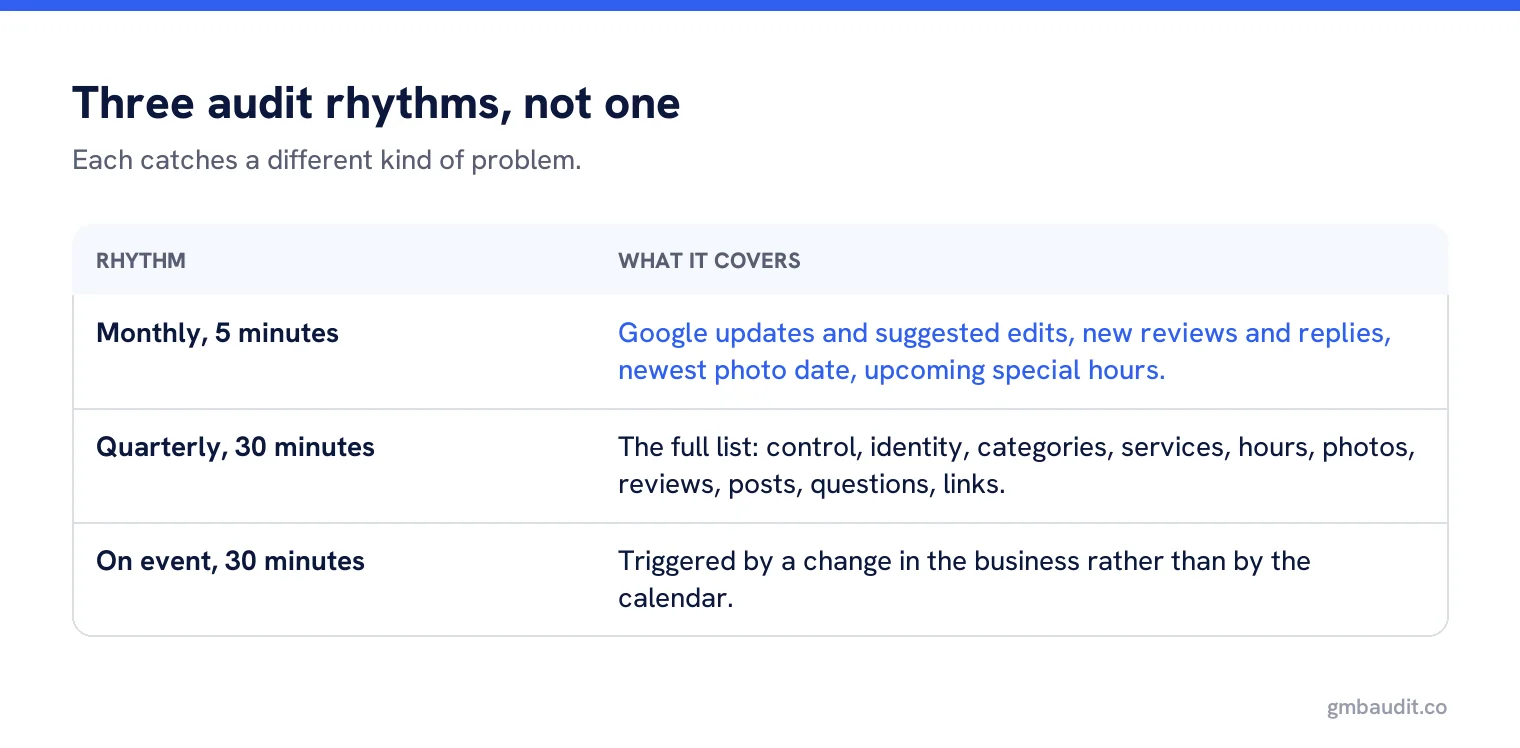
Three rhythms, not one
| Rhythm | What it covers | Time |
|---|---|---|
| Monthly | Google updates and suggested edits, new reviews and replies, newest photo date, upcoming special hours. | 5 minutes |
| Quarterly | The full list: control, identity, categories, services, hours, photos, reviews, posts, questions, links. | 30 minutes |
| On event | Everything, triggered by a change in the business rather than by the calendar. | 30 minutes |
Why monthly exists at all
Because of edits you did not make. Google’s page on Google updates to your profile explains that if sources report your information is incorrect or outdated, Google may update the profile, and that in the editor blue text marks information changed by Google.
Suggested edits from the public work on a clock. Google says that when a suggested edit needs your review you may get an email or an in-product notification, and that you have four days to accept or reject it. If you do not respond within four days, Google may publish the update anyway if other public information supports it, such as your own website.
Four days is shorter than most people’s reporting cycle. That single fact is the argument for a monthly glance rather than a quarterly one, and for making sure the notification email goes somewhere a human reads.
What goes in the five minute check
- Any blue text or update notification in the editor.
- New reviews since last month, and whether they have replies.
- Date of the newest photo, and who added it.
- Special hours for anything coming up in the next six weeks.
That is it. Resist adding to this list, because a five minute check that grows into twenty stops happening.
The events that should trigger an audit
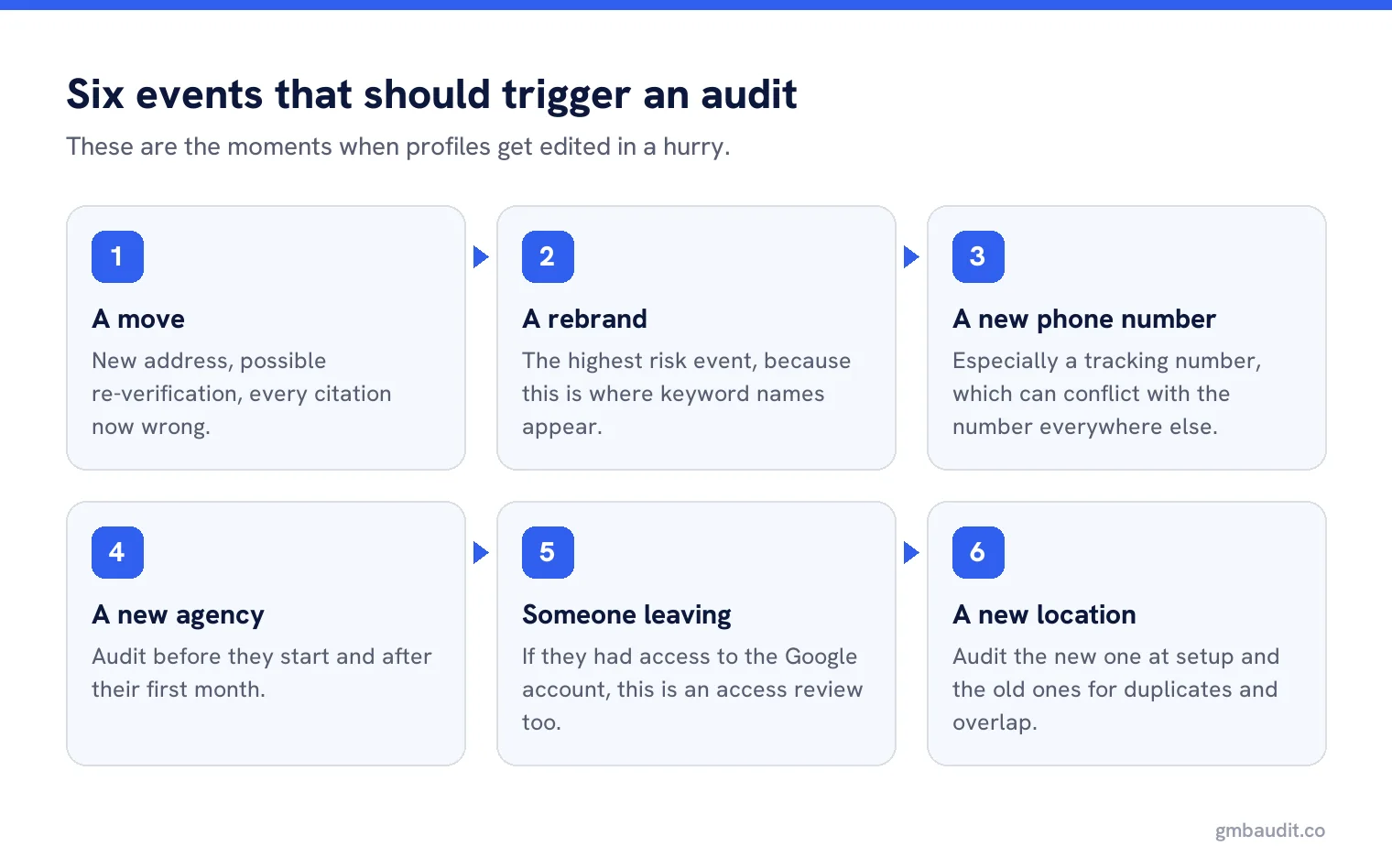
A move
New address, possible re-verification, every citation now wrong, and the old address still cached across the web.
A rebrand or name change
The highest risk event there is, because this is where keyword-stuffed names get introduced.
A new phone number
Especially a tracking number, which needs care to avoid conflicting with the number everywhere else.
A new agency or freelancer
Audit before they start and after their first month. Not out of suspicion, but because access and categories tend to change quietly.
Someone leaving
If they had access to the Google account, the audit is also an access review.
A new location
Audit the new one at setup, and the existing ones for duplicates and service area overlap.
What changes while you are not looking
It helps to know where the drift comes from, because it explains why the calendar matters more than the checklist. Google describes four sources of profile information: publicly available content such as your own website, licensed data from third parties, contributions from users including business owners, and Google’s own interactions with the place.
In practice that means your profile can change because somebody updated a directory you forgot you were listed in, because a visitor suggested a different opening time, because your website changed and Google read it, or because enough people reported the same thing. None of those events sends you a letter. Some of them send a notification that lands in an inbox nobody checks. The monthly five minutes exists to catch all of it in one place.
How often for an agency
With clients, the cadence has to survive contact with a timesheet. A workable split is a five minute check on every profile monthly, a full audit on a rotating third of the portfolio each month so everything is covered quarterly, and an immediate audit on any profile where something visible changes. Spread the full audits rather than doing them all in the last week of the quarter, which is what turns a useful process into a box-ticking exercise.
Bill it as monitoring rather than as a one-off audit. A single audit at the start of an engagement finds a pile of problems and then creates the impression the work is done.
What too often looks like
Weekly full audits produce noise: review counts that moved by one, a photo added, nothing to decide. Worse, they train whoever runs them to skim. The point of a fixed order is that it is read properly, and nobody reads the same 40 line list carefully every Monday.
There is one exception. Profiles that have just been reinstated after a suspension, or that have had an edit war with a suggested-edit contributor, are worth checking weekly for a month. Not forever, just until it settles.
Who should run it
Whoever runs the audit needs two things: access to the dashboard and permission to be unwelcome. An audit carried out by the person who built the profile tends to find nothing, because they are marking their own work. If the business is small enough that this is unavoidable, the fixed order is what saves you, since a list does not know who wrote the description.
Keep the old ones
An audit is most useful as a pair. The current state tells you what to fix. The previous one tells you what changed, who changed it, and whether the work you did last quarter held. Keep them in dated folders with the screenshots, because the day you need to show that a field used to say something different is the day Google has already overwritten it.
Let the checks run themselves
Scheduled audits across every profile you manage, with alerts when something changes between runs.
Frequently asked questions
How often should a Google Business Profile be audited?
A five minute check monthly, a full audit quarterly, and an immediate audit after a move, rebrand, new phone number, new agency or new location.
Why monthly rather than quarterly?
Because suggested edits run on a four day clock. Google says you have four days to accept or reject certain edits before it may publish them anyway.
How do I know if Google changed my profile?
Google marks information it has changed in blue text in the profile editor, and shows a notification at the top of the page when updates are waiting.
How should an agency schedule audits?
Check every profile briefly each month and fully audit a rotating third of the portfolio, so everything gets a full pass each quarter without a crunch.
Can you audit too often?
Yes. Weekly full audits produce noise and train people to skim. The exception is a profile that has just been reinstated, which is worth watching weekly for a month.
Sources
The Google documentation behind the guidance on this page. Google changes these pages without notice, so check the date on any figure before you rely on it.